
Lab 3.2 - Tunnel Protocols: IPIP, GRE, EoIP, L2TP, PPTP, SSTP, PPPoE

Introduction
Lab 3.1 introduced the idea of a tunnel: one packet wrapped inside another, carried across a shared network, and unwrapped at the far end. It built two examples - GRE for site-to-site and PPTP for remote access and left the rest of the field for later. This lab works through the full set of tunnel protocols that RouterOS offers in its VPN and tunnelling toolkit: IPIP, GRE, EoIP, L2TP, PPTP, SSTP, and PPPoE.
Each protocol solves a slightly different problem. IPIP and GRE carry layer 3 packets between two routers with the least possible overhead. EoIP carries layer 2 Ethernet frames, so it can stretch a LAN segment across the WAN rather than simply routing between subnets. L2TP, PPTP, and SSTP carry the Point-to-Point Protocol (PPP) so that remote clients can authenticate and receive an address from the VPN server, the same model used by dial-up and DSL access. PPPoE is the access version of the same idea: it carries PPP frames over Ethernet, which is how most consumer broadband connections reach an ISP.
The protocols differ in what they carry, how they are transported, whether they encrypt, and what breaks when they fail. The point of the lab is not to memorise a table of commands but to see, on the same topology, how each protocol appears in RouterOS, how it is routed, and what a failure looks like from the router's point of view.
Work through the steps in order. Each protocol is configured, verified, and then removed before the next one begins, so that overlapping routes and interfaces do not interfere with the test you are doing.
Terminology Definitions
Tunnel Protocol: A protocol that encapsulates one protocol's packets or frames inside another, creating a virtual link across an intermediate network. Tunnel protocols differ in the layer they carry (layer 2 frames or layer 3 packets), the transport they use to cross the network, and whether they provide encryption.
IPIP (IP-in-IP): The simplest tunnel. An IPv4 packet is placed inside an outer IPv4 packet with IP protocol number 4. Overhead is 20 bytes (the outer IP header). IPIP carries only IPv4 and provides no encryption or authentication.
GRE (Generic Routing Encapsulation): Defined in RFC 2784. Wraps any layer 3 protocol inside an outer IP packet with IP protocol number 47 and a small GRE header. Introduced in Lab 3.1. GRE carries IPv4 and IPv6 and can optionally carry a key, which lets several tunnels between the same endpoints be told apart.
EoIP (Ethernet over IP): A MikroTik specific tunnel that carries complete Ethernet frames, including broadcasts and multicasts, inside IP packets. Because it is layer 2, an EoIP interface can be placed in a bridge alongside a physical LAN port, making two remote LAN segments behave as one broadcast domain. Both ends must use the same tunnel-id.
PPP (Point-to-Point Protocol): A link-layer protocol that provides a framed, authenticated, point-to-point connection and assigns network-layer addresses through IPCP. PPP carries IP and is the basis of PPTP, L2TP, SSTP, and PPPoE.
L2TP (Layer 2 Tunnelling Protocol): Carries PPP frames over UDP port 1701. L2TP on its own provides tunnelling only; it does not encrypt. It is normally combined with IPsec (L2TP/IPsec) for confidentiality, which is covered in a later lab.
PPTP (Point-to-Point Tunnelling Protocol): Carries PPP over TCP port 1723 for control and GRE (protocol 47) for data. Encryption, when present, is MPPE applied to PPP, and it relies on MS-CHAPv2, which is cryptographically weak. Covered in Lab 3.1.
SSTP (Secure Socket Tunnelling Protocol): Carries PPP inside a TLS session over TCP port 443. Because it looks like HTTPS to a firewall, it passes through networks that block other VPN protocols. The server must present a certificate, and the client may verify it.
PPPoE (Point-to-Point Protocol over Ethernet): Carries PPP sessions directly in Ethernet frames (EtherTypes 0x8863 for discovery and 0x8864 for sessions). It does not cross routed networks by itself; it is used on a single Ethernet segment, most commonly between a customer router and an ISP's access equipment.
MTU (Maximum Transmission Unit): The largest packet an interface can send without fragmentation. Every encapsulation adds overhead, so the MTU available inside a tunnel is smaller than the MTU of the underlay. Mismatched MTUs are a common cause of tunnels that carry small packets but stall on large ones.
Tunnel Interface: A virtual interface created by a tunnel protocol. RouterOS creates interfaces such as ipip-to-branch, gre-to-branch, and eoip-to-branch for the client or site-to-site side, and dynamic interfaces such as l2tp-in1, pptp-in1, sstp-in1, and pppoe-in1 on the server side when a remote client connects.
Underlay and Overlay: The underlay is the network that carries the encapsulated packets (the WAN, 203.0.113.0/30 and 203.0.113.4/30 in this lab). The overlay is the virtual network built inside the tunnel (the 10.255.x.0 subnets used in each step).
Lab Topology
The topology is the same as Lab 3.1. R1 is the headquarters router, R2 is the branch router, and R3 simulates a remote worker. VPC1 and VPC2 are end hosts on the HQ and Branch LANs.
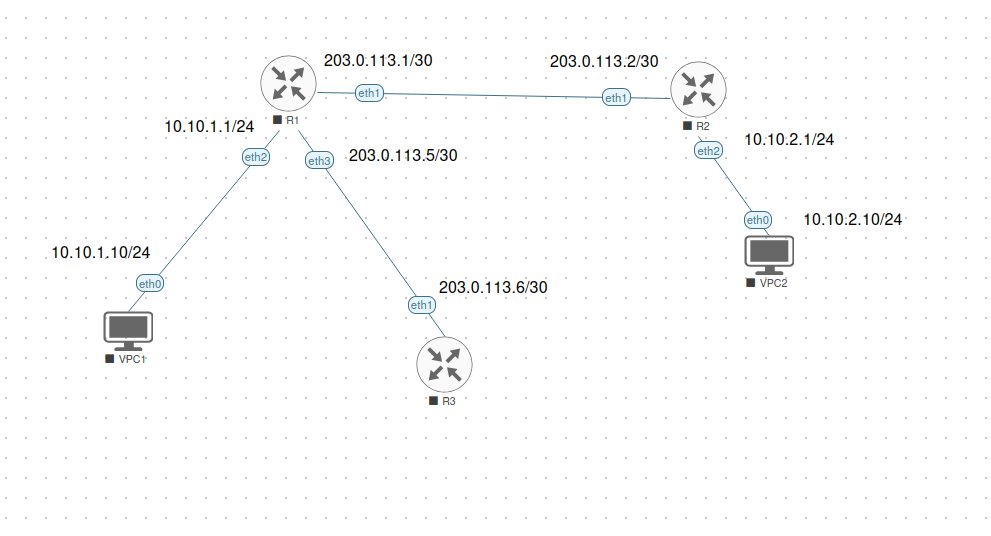
Site-to-site steps (IPIP, GRE, EoIP, and PPPoE) run over the R1–R2 WAN link on ether1. Remote-access steps (L2TP, PPTP, and SSTP) run between R3 and R1 over ether3.
Network summary:
| Device | Interface | Address | Purpose |
|---|---|---|---|
| R1 | ether1 | 203.0.113.1/30 | WAN to R2 (site-to-site underlay) |
| R1 | ether2 | 10.10.1.1/24 | HQ LAN |
| R1 | ether3 | 203.0.113.5/30 | WAN to R3 (remote access underlay) |
| R2 | ether1 | 203.0.113.2/30 | WAN to R1 |
| R2 | ether2 | 10.10.2.1/24 | Branch LAN |
| R3 | ether1 | 203.0.113.6/30 | WAN to R1 |
| VPC1 | eth0 | 10.10.1.10/24 | HQ workstation |
| VPC2 | eth0 | 10.10.2.10/24 | Branch workstation |
Overlay address plan:
Each protocol uses its own overlay subnet so that results from one step cannot be mistaken for another.
| Protocol | Overlay subnet | R1 side | Far side |
|---|---|---|---|
| GRE | 10.255.1.0/30 | 10.255.1.1 | 10.255.1.2 (R2) |
| PPTP | 10.255.2.0/29 | 10.255.2.1 (server) | 10.255.2.2–5 (pool) |
| L2TP | 10.255.3.0/29 | 10.255.3.1 (server) | 10.255.3.2–5 (pool) |
| IPIP | 10.255.4.0/30 | 10.255.4.1 | 10.255.4.2 (R2) |
| EoIP | 10.255.5.0/30 | 10.255.5.1 | 10.255.5.2 (R2) |
| PPPoE | 10.255.6.0/30 | 10.255.6.1 | 10.255.6.2 (R2) |
| SSTP | 10.255.7.0/29 | 10.255.7.1 (server) | 10.255.7.2–5 (pool) |